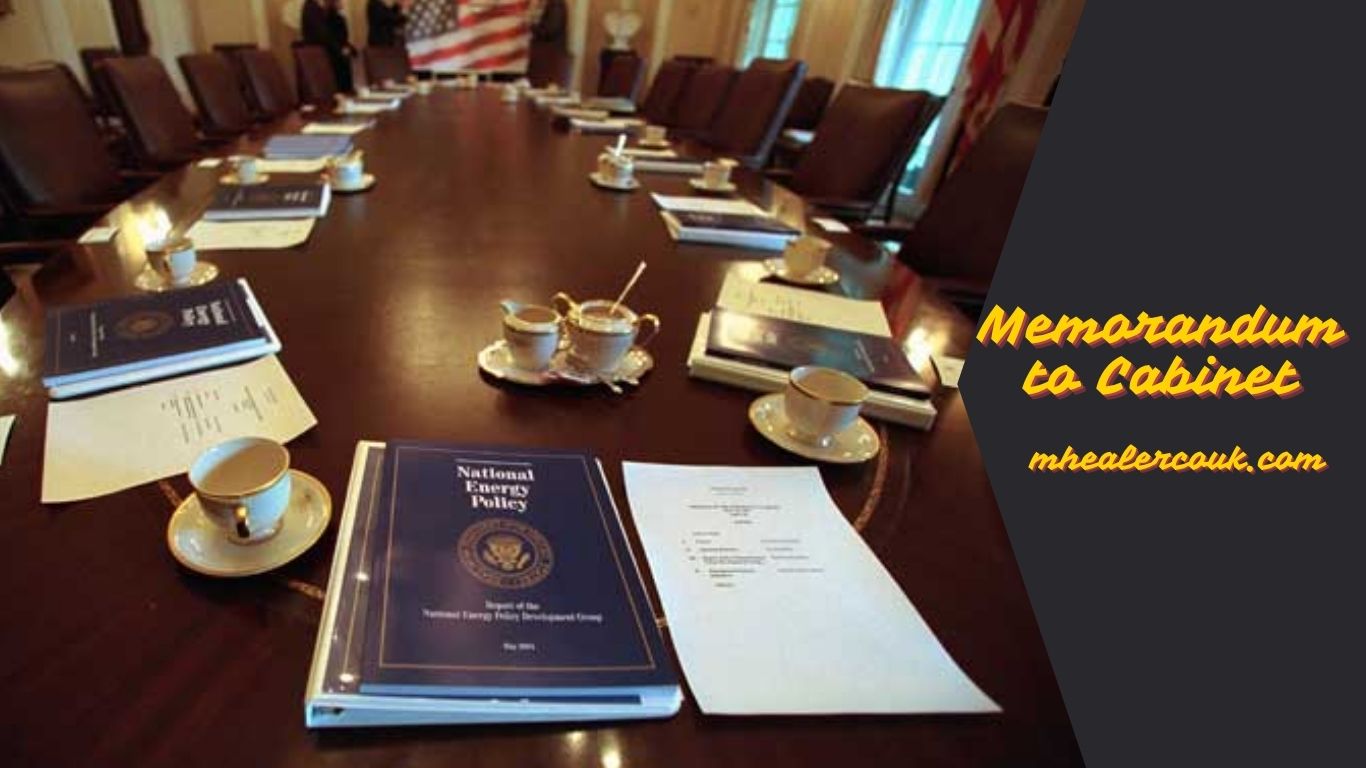
Memorandum to Cabinet: Meaning, Process, Structure, and Importance
If you have searched for “memorandum to cabinet,” you may want to understand what this term means, how this document is prepared, and why it matters in government decision-making. A Memorandum to Cabinet is a formal policy submission used to present an issue, explain possible solutions, and request a decision from Cabinet.
The term is especially associated with parliamentary governments such as Canada. It is important to understand that the United States uses a different executive and Cabinet structure. Similar policy and decision documents exist in the U.S. government, but they are not necessarily the same as a Canadian Memorandum to Cabinet.
A Memorandum to Cabinet is more than a basic office memo. It is part of a formal policy process. It brings together evidence, policy choices, financial information, legal considerations, risks, and implementation plans so senior government leaders can make an informed decision.
What Is a Memorandum to Cabinet?
A Memorandum to Cabinet is a confidential government policy submission prepared by a department and sponsored by a minister. Its purpose is to bring an important policy issue before Cabinet and request a decision.
In simple terms, it is a government decision paper.
A typical Memorandum to Cabinet explains:
- What problem the government needs to address
- Why the issue requires Cabinet attention
- What options are available
- What each option could cost
- What benefits and disadvantages each option has
- What legal or regulatory issues may exist
- What risks could occur
- Which option the responsible minister recommends
- What decision Cabinet is being asked to make
The document gives ministers the information needed to consider a policy proposal before making a collective government decision.
A Memorandum to Cabinet is therefore closely connected to public policy, Cabinet decision-making, government departments, ministerial responsibility, policy analysis, and executive government.
How Does a Memorandum to Cabinet Work?
The process normally begins when a government department identifies an issue that requires a significant policy decision.
Officials research the issue and gather relevant information. They may consult other departments, legal advisers, financial specialists, stakeholders, experts, and central government agencies.
The department then develops possible policy options.
After analysis, the responsible minister decides which proposal should be brought forward. Officials prepare the Memorandum to Cabinet, and the minister sponsors the submission.
The document then enters the government’s Cabinet process.
A simplified process is:
- Identify the policy issue.
- Research the problem.
- Develop possible solutions.
- Analyze costs, benefits, and risks.
- Consult relevant departments and organizations.
- Develop the recommended option.
- Prepare the Memorandum to Cabinet.
- Obtain ministerial approval.
- Submit the document through the Cabinet process.
- Ministers consider the proposal.
- Cabinet makes or confirms the appropriate decision.
- Government officials begin the next stage of implementation.
The precise process can vary between governments and can change over time.
Who Prepares a Memorandum to Cabinet?
A Memorandum to Cabinet is normally prepared by officials within the government department responsible for the policy issue.
The preparation can involve a large team.
Also Read:Tarnplanen: Uses, Materials, Benefits, and Safety
Depending on the subject, contributors may include:
- Policy analysts
- Economists
- Lawyers
- Financial analysts
- Program managers
- Regulatory specialists
- Scientists or technical experts
- Communications officials
- Senior departmental executives
The responsible minister sponsors the submission.
This creates an important relationship between elected officials and public servants. Public servants normally provide research, professional analysis, evidence, and implementation advice, while the minister provides political and policy direction and presents the proposal through the Cabinet system.
In Canada’s federal system, the Privy Council Office also plays an important role in supporting Cabinet and its committees.
What Is Included in a Memorandum to Cabinet?
The exact structure can differ depending on the government and subject, but a Memorandum to Cabinet normally contains several important parts.
The first is the recommendation.
This tells ministers what decision the sponsoring minister is asking Cabinet to make.
The document may then explain the issue, background, policy options, financial implications, legal considerations, risks, consultations, and implementation requirements.
A strong MC should allow ministers to understand both the recommendation and the reasoning behind it.
The document should also make important uncertainties visible.
For example, if a policy depends on uncertain economic forecasts, those limitations should be explained rather than hidden.
This helps decision-makers understand not only what officials recommend but also how confident they can be in the supporting analysis.
What Is the Ministerial Recommendation in an MC?
The ministerial recommendation is one of the most important parts of a Memorandum to Cabinet.
It identifies the action the sponsoring minister wants Cabinet to approve.
A recommendation should normally be:
- Clear
- Specific
- Practical
- Consistent with the analysis
- Connected to the government’s authority
- Supported by evidence
The recommendation should not force ministers to search through the document to discover what they are being asked to approve.
For example, a recommendation might request approval to develop a new program, proceed with legislation, change an existing policy, or provide funding for a defined purpose.
The recommendation is not automatically the final Cabinet decision.
Cabinet may approve it, reject it, change it, request additional information, or select another option.
How Are Policy Options Presented in a Memorandum to Cabinet?
Policy options allow Cabinet to compare different ways of responding to an issue.
A good policy analysis should not simply describe one preferred solution without considering reasonable alternatives.
Depending on the problem, options might include:
- Continuing the existing approach
- Making limited changes
- Introducing a new program
- Changing regulations
- Passing new legislation
- Providing financial support
- Working with another government
- Delaying action while gathering additional evidence
Each option can be evaluated using factors such as cost, effectiveness, timing, feasibility, legal authority, public impact, and risk.
The recommended option should be clearly connected to this comparison.
This makes the decision-making process more transparent within the limits of Cabinet confidentiality.
What Are the Financial Considerations in a Memorandum to Cabinet?
Financial analysis is an important part of government policy decisions.
A proposal may require significant public resources, so ministers need to understand the expected financial impact.
Financial considerations can include:
- Initial program costs
- Long-term operating costs
- Staffing costs
- Technology expenses
- Procurement
- Grants or financial assistance
- Infrastructure
- Administrative expenses
- Expected savings
- Funding sources
A strong analysis should distinguish between short-term and long-term costs.
For example, a program may appear affordable during its first year but require much larger annual spending afterward.
Decision-makers therefore need to understand the full financial picture.
Financial information can also help compare policy options. A less expensive option may have fewer benefits, while a more expensive option may provide greater results.
The purpose is not simply to select the cheapest proposal. It is to help Cabinet understand the relationship between public resources and expected outcomes.
What Legal Issues Can a Memorandum to Cabinet Address?
Government policies must operate within the law.
For this reason, legal analysis can be an important part of a Memorandum to Cabinet.
Legal considerations may involve:
- Existing legislation
- Constitutional authority
- Regulatory powers
- Privacy requirements
- Administrative law
- Human rights
- Treaty obligations
- Litigation risk
- Required legislative amendments
- Government authority to implement the proposal
Legal advisers can identify potential problems before Cabinet makes a decision.
This is especially important when a proposal would require new legislation or changes to existing laws.
A Cabinet decision does not automatically create legal authority for every proposed action. The government must still follow the applicable legislative, regulatory, constitutional, and administrative requirements.
Why Is a Memorandum to Cabinet Confidential?
Confidentiality is a major feature of Cabinet decision-making.
Also Read:Loralee Czuchna: Biography, Marriage to Don Knotts & Life Story
Government leaders need an environment where they can discuss policy choices before a final decision is made.
A confidential process allows ministers and officials to:
- Consider different options
- Challenge assumptions
- Discuss risks
- Change recommendations
- Explore alternatives
- Debate difficult issues
- Develop a collective position
If every early-stage policy discussion were immediately public, decision-makers could have less freedom to explore possible approaches before reaching a final position.
In Canada, Cabinet confidences receive specific protection under access-to-information law. Certain records prepared for presenting proposals or recommendations to Cabinet may fall within those protections.
However, the label of a document alone does not answer every legal question about confidentiality. The purpose, contents, applicable law, and circumstances surrounding the document matter.
Can a Memorandum to Cabinet Become Public?
Sometimes Cabinet-related documents can eventually become public, but disclosure depends on the applicable legal and administrative rules.
Information may become available through:
- Access-to-information processes
- Historical archives
- Government releases
- Public inquiries
- Court proceedings
- Parliamentary records
- Other authorized disclosure mechanisms
Some information may remain protected.
Researchers should therefore identify whether a document is:
- Current or historical
- Draft or final
- Confidential or released
- Complete or redacted
- Official or unofficial
- A recommendation or a record of an actual decision
A document described online as a “Memorandum to Cabinet” should not automatically be assumed to be an official, final, publicly released government document.
Memorandum to Cabinet vs. U.S. Government Memoranda
For U.S. readers, one of the most important points is that the Canadian Memorandum to Cabinet should not be confused with U.S. executive memoranda.
Canada and the United States have different systems of government.
Canada uses a parliamentary system in which the Prime Minister and Cabinet have a central role in executive decision-making.
The United States uses a presidential system.
The U.S. government does use documents such as presidential memoranda, agency memoranda, policy papers, decision memoranda, briefing documents, and other executive materials.
Some of these may perform similar practical functions, but they are not automatically equivalent to a Canadian Memorandum to Cabinet.
This distinction matters when researching government documents, especially in academic, legal, or policy contexts.
If an American reader encounters the phrase “memorandum to cabinet,” checking the country and government department should be the first step.
What Is the Role of the Privy Council Office in a Memorandum to Cabinet?
In Canada’s federal government, the Privy Council Office supports the Prime Minister, Cabinet, and Cabinet committees.
It is an important part of the machinery surrounding Cabinet decision-making.
The PCO can support coordination, provide advice on the Cabinet process, and assist with the preparation and handling of Cabinet business.
Departments may work with the PCO while developing important policy submissions.
This helps ensure that proposals are properly prepared and presented through the appropriate government decision-making process.
The PCO should not be confused with a government department responsible for delivering ordinary public programs. Its role is closely connected to supporting the Prime Minister and Cabinet and coordinating central government processes.
How Does a Memorandum to Cabinet Support Policy Analysis?
A Memorandum to Cabinet turns policy research into a decision-focused format.
Policy analysis often involves asking:
- What is the problem?
- Why does it exist?
- Who is affected?
- What evidence is available?
- What could government do?
- What would each option cost?
- What are the likely benefits?
- What could go wrong?
- How could the policy be implemented?
- How would success be measured?
An MC brings these questions together.
This is why the document is useful not only as a government record but also as an example of applied public policy analysis.
It shows how research, economics, law, administration, and political judgment can come together in government decision-making.
What Makes a Good Memorandum to Cabinet?
A strong Memorandum to Cabinet should be clear, balanced, evidence-based, and focused on the decision being requested.
Several qualities are especially important.
Clear Writing
Ministers should be able to understand the central issue without unnecessary jargon.
Reliable Evidence
Important claims should be supported by credible information.
Balanced Analysis
The document should explain meaningful disadvantages and risks rather than presenting only the positive side.
Realistic Options
Policy alternatives should be practical and relevant.
Accurate Financial Information
Costs and funding requirements should be presented clearly.
Strong Legal Analysis
Legal limitations should be identified before implementation begins.
Practical Implementation
The government should understand how the approved proposal could actually be delivered.
Clear Recommendation
The final recommendation should follow logically from the evidence and analysis.
A document can contain excellent research but still be weak if the requested decision is unclear.
What Are Common Problems With a Memorandum to Cabinet?
Several problems can reduce the quality of an MC.
One common issue is excessive background information.
Ministers need context, but too much history can make the main decision difficult to identify.
Another problem is weak comparison between options.
If the document only explains the preferred approach, ministers may not have enough information to understand why it is better than the alternatives.
Unclear costs are another concern.
Also Read:G15Tools Com Contact: Complete Guide to Contact G15Tools
A proposal should identify both immediate and longer-term financial implications where relevant.
Ignoring risk can also weaken a submission.
Every major policy has uncertainty. A credible MC should explain important risks and how they might be managed.
Finally, inconsistent numbers, timelines, recommendations, or assumptions can reduce confidence in the entire document.
Accuracy matters because Cabinet decisions can have major public consequences.
Frequently Asked Questions About Memorandum to Cabinet
Is a Memorandum to Cabinet legally binding?
A Memorandum to Cabinet itself is generally a policy submission rather than a law or regulation. Its legal effect depends on the government decision that follows and the legal authority available to implement that decision.
A Cabinet approval may authorize officials to proceed with certain steps, but legislation, regulations, contracts, or other legal instruments may still be required.
Who can access a Memorandum to Cabinet?
Access depends on the applicable government rules and confidentiality protections.
Authorized government officials may have access as part of the Cabinet process. Public access may be restricted where Cabinet confidence or another legal protection applies.
Historical or released documents may eventually become available through appropriate disclosure or archival processes.
Can an MC recommend more than one option?
Yes. A Memorandum to Cabinet can present multiple policy options for consideration.
However, the ministerial recommendation normally identifies the preferred course of action or the specific decision being requested.
Presenting alternatives helps ministers understand the trade-offs before making a decision.
How long does it take to prepare a Memorandum to Cabinet?
There is no universal preparation time.
A simple policy issue may require relatively limited analysis, while a major legislative or financial proposal can require extensive research, consultation, legal review, financial analysis, and interdepartmental coordination.
The timeline depends on the complexity and urgency of the issue and the government’s Cabinet procedures.
Is a Memorandum to Cabinet the same in every country?
No.
The phrase is closely connected with parliamentary Cabinet systems, and its exact meaning and procedure depend on the country’s constitutional and administrative structure.
For example, the Canadian federal system has a formal Memorandum to Cabinet process. The United States has a different presidential system and uses different types of executive and policy documents.
Conclusion
A Memorandum to Cabinet is a formal government policy submission used to present an important issue, analyze possible solutions, and request a decision from Cabinet.
Its core purpose is simple: help senior government decision-makers understand a problem and choose an appropriate course of action.
A typical Memorandum to Cabinet can cover the problem, background, policy options, recommendation, evidence, costs, legal issues, risks, consultations, and implementation.
The document is particularly important in Canada’s federal government, where Cabinet plays a central role in collective executive decision-making.
The most important point is to understand the institutional difference. A Canadian Memorandum to Cabinet should not automatically be treated as the same thing as a U.S. presidential memorandum or other executive document.
When researching this topic, always verify the country, department, date, document status, confidentiality rules, and final government decision. This approach makes it easier to distinguish an official Cabinet submission from a general policy paper, leaked document, draft, briefing note, or secondary description.
Ultimately, the value of a Memorandum to Cabinet comes from its ability to organize complex policy information into a form that supports informed government decision-making.